
The best time is between September and March. The weather stays cool, skies remain clear, and most waterfalls are still active after the monsoon. April to June is pleasant too but can get crowded with summer travellers.
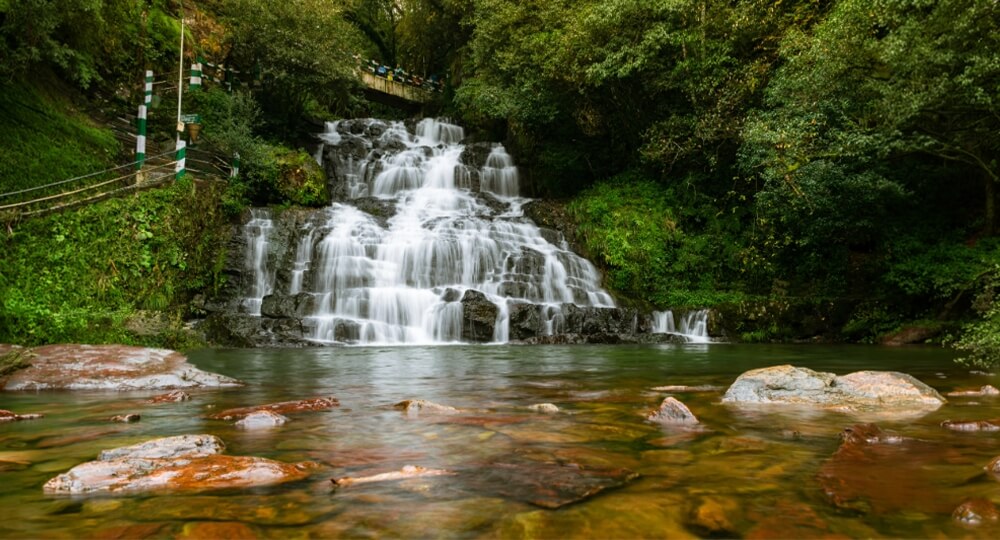
Shillong works best for those who want to slow down a bit. Here, you let leisurely walks replace hurried plans. Rain taps gently on roofs, guitar notes drift from cafés, and church choirs elevate the evenings. The city’s relaxed pace invites you to settle into its rhythm rather than chase sights.
Set on the Khasi hills, Shillong stays cool and green for most of the year. Pine-lined roads, quiet neighbourhoods, and open skies define daily life. After a shower, mist rolls across rooftops and valleys, softening the landscape and the mood.
The journey into Shillong already shifts your tempo. As the road climbs from the plains, forests thicken, lakes appear, and small tea stalls break the drive. By the time you arrive, the noise of larger cities feels distant.
In Shillong, time stretches comfortably. You circle lakes on foot, browse local markets, and spend unhurried hours in music-filled cafés. Even the busy parts of town feel calm and orderly.
For travellers who value leisure over packed itineraries, Shillong Tour Packages offer a natural fit. Days stay flexible, distances stay short, and the focus stays on experience rather than movement.
Shillong sits on the Khasi Hills in Meghalaya, at an average elevation of about 1,525 metres above sea level. Its high plateau setting gives the city a cooler climate than the Assam plains below. Guwahati, the nearest major city, lies roughly 100 kilometres away, with the road rising gradually through valleys and forested slopes.
The landscape around Shillong features gentle rolling hills, open grasslands, and pine-covered slopes rather than steep mountains. Broad ridgelines create natural viewpoints and support the city’s spread-out layout, with neighbourhoods woven into the terrain.
Several small rivers and streams originate in and around Shillong, feeding larger water systems such as the Umiam. Umiam Lake, a large reservoir west of the city, stands out as a key geographical feature, offering open-water views and influencing local weather patterns.
Vegetation changes with elevation and rainfall. Pine forests dominate the city’s slopes, while grasslands cover many hilltops. To the south, the terrain shifts quickly into denser subtropical forests, leading to sharp visual contrasts over short distances toward the wetter Cherrapunji region.
Shillong’s climate follows a highland monsoon pattern: mild days, cool nights, and heavy rainfall between June and September shape daily life. Mist and low cloud cover appear often, while winter months bring clear skies and crisp mornings.
Shillong’s social fabric is rooted in its tribal heritage, shaped mainly by the Khasi community. Long before urban development, Khasi clans lived across these hills under matrilineal traditions, where lineage and inheritance passed through the mother’s line. Community councils known as dorbars continue to guide local governance, land use, and social order alongside modern systems. Land, forests, and water hold shared social and spiritual value, protected through customary laws and sacred groves. Christianity, introduced during the colonial period, plays a central role in education and community life, while traditional values remain deeply respected. Together, these influences give Shillong its calm pace, strong civic discipline, and close connection to nature.
Shillong’s history grows from its hills and communities rather than from royal dynasties or empires. Long before colonial records, the Khasi people lived across these uplands in organised clan-based societies. Daily life was guided by local councils known as dorbars, which handled governance, conflict resolution, and community decisions.
Land, forests, and water sources were managed through customary laws that emphasised shared responsibility. Nature held social and spiritual importance, not only practical value. Sacred groves, hilltops, and streams formed centres of worship and memory, creating a close and enduring link between the landscape, belief systems, and community life.
In the 19th century, the British Empire expanded into the Khasi Hills. After the British annexed Assam, they searched for a cooler administrative centre away from the plains. In 1874, Shillong was chosen as the new headquarters of Assam due to its elevation, mild climate, and central position. This decision marked a turning point, transforming a quiet hill settlement into a planned colonial town.
British administrators introduced wide roads, bungalows, churches, schools, and government offices. The layout followed hill-station principles, with scattered residential zones, open spaces, and tree-lined avenues designed to withstand heavy rainfall. Missionary institutions played a key role in education, contributing to high literacy and the widespread use of English alongside Khasi.
Shillong remained the capital of Assam for nearly a century. During this period, it grew as an administrative, educational, and cultural centre for the region. The city attracted students, civil servants, and traders from across the Northeast, giving it a cosmopolitan yet orderly character.
In 1972, Meghalaya became a separate state, carved out of Assam, and Shillong was named its capital. This political shift reinforced Khasi identity within the urban fabric while retaining colonial-era institutions. Government offices expanded, but the city preserved its low-rise skyline and measured pace.
Today, Shillong’s history lives quietly in its churches, schools, neighbourhoods, and civic routines. Traditional dorbars continue alongside modern governance. Colonial buildings coexist with Khasi homes and contemporary cafés. The city’s past does not dominate its present, but it shapes the calm discipline, community focus, and cultural confidence that define Shillong today.
These guidelines help ensure a smooth, respectful stay while travelling through Shillong and the nearby Khasi Hills.
The best time is between September and March. The weather stays cool, skies remain clear, and most waterfalls are still active after the monsoon. April to June is pleasant too but can get crowded with summer travellers.
Yes. While Khasi cuisine often includes meat, Shillong has many vegetarian cafés and restaurants, especially around Police Bazaar, Laitumkhrah, and the main roads. South Indian, North Indian, and vegan meals are also easy to find.
Yes. The city’s mild climate, compact layout, and safe environment make it comfortable for families. Children enjoy places like Ward’s Lake, Lady Hydari Park, and the Don Bosco Museum. Day trips to waterfalls and lakes are suitable for all ages.
Shillong has a small domestic airport (Umroi) connected mainly to Guwahati and Kolkata. The nearest major hub is Guwahati Airport, about 120 km away. From there, regular taxis and shared cabs operate to Shillong via scenic mountain roads.
Yes. Many travellers combine Shillong with nearby attractions such as Cherrapunji, Mawlynnong, Dawki, and Jowai. For longer itineraries, Shillong can also link with Kaziranga National Park in Assam or Guwahati city.
The main local language is Khasi, followed by English and Hindi, both of which are widely spoken in hotels, cafés, and shops.
Local taxis are the most common mode of travel. They operate on both shared and private hire basis. Walking works well for short distances, especially around the city centre, but for scenic points like Shillong Peak or Elephant Falls, taxis are preferred.
Pack light woollens, especially from October to February, as evenings can get chilly. Bring comfortable walking shoes, a rain jacket or umbrella year-round, and cash for small purchases since some local stalls may not accept digital payments.
No major safety concerns, but roads can get slippery during the monsoon. Use licensed taxis, avoid venturing near waterfalls during heavy rain, and follow local advice on trail conditions when trekking or exploring rural routes.
Share your travel dates and preferences. Our experts will create a personalised holiday for you.
☎ +91 83675 01501
✉ travelguru@gmail.com