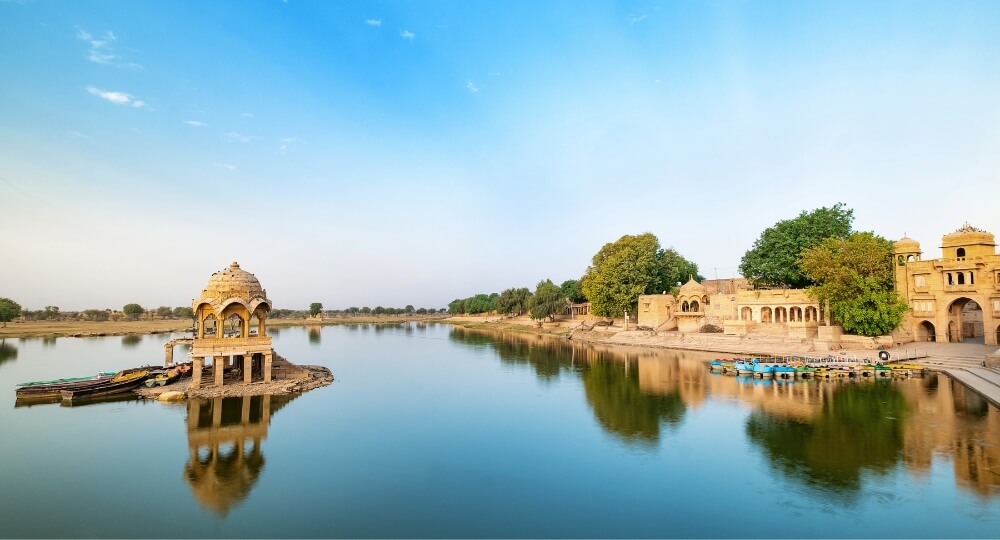
Jaisalmer rises from the Thar desert as a city shaped by sand, movement, and long stretches of quiet. The colour barely changes. Yellow sandstone absorbs heat throughout the day and slowly releases it by evening as the light fades, walls soften, and lanes grow still. You hear footsteps on stone, temple bells in the distance, and wind passing through carved jharokhas. The city does not rush to get your attention. It asks you to slow down.
For Indian travellers, Jaisalmer feels far from the everyday yet rooted in something familiar. The desert recalls Kutch and western Rajasthan. Social customs echo older trading towns across North India. Life here values patience, continuity, and shared space. Jaisalmer Tour Packages suit travellers drawn to history, open horizons, and time away from crowded hill stations and busy coastlines.
Table of Content:
- About Jaisalmer
- Tidbits About Jaisalmer
- Travel Requirements
- How to Reach Jaisalmer
- Top 6 Reasons to Choose Jaisalmer Tour Packages
- Best Places to Visit With Our Jaisalmer Tour Packages
- Other Places to Explore
- Culture, Arts & Architecture
- Cuisine & Local Flavours
- Shopping in Jaisalmer
About Jaisalmer
Jaisalmer lies deep within the Thar Desert in western Rajasthan, close to India’s international border. Geography shapes the city completely. Land, climate, water availability, and wind patterns determine how people live, build, and move. Jaisalmer does not stand apart from its landscape. It rises gently from it.
The terrain around Jaisalmer alternates between shifting sand dunes and hard, rocky ground. Soft dunes dominate open stretches, while firmer soil appears closer to settlements. This mix limited large-scale farming and encouraged grazing, seasonal cultivation, and trade-based livelihoods. Vegetation is sparse. Hardy plants such as khejri trees and desert grasses survive in areas with minimal moisture, helping stabilise soil and support livestock.
The city sits on relatively flat land, with Trikuta Hill providing the only natural elevation. This hill offered visibility and protection, which is why the fort was built on its summit. In the absence of hills, heat and wind move freely across the region. Sunlight stays intense and constant. Shade is a design choice rather than a natural feature.
Jaisalmer experiences an extreme desert climate. Summers bring intense heat. Winters remain dry, with sharp temperature drops after sunset. Rainfall stays low and unpredictable, arriving briefly during the monsoon. These conditions shaped compact settlement patterns. Buildings stand close together. Streets remain narrow. Open spaces cluster near water sources rather than spreading across the city.
Water defines settlement more than any other factor. Natural rivers do not flow through the region. As a result, people depend on rainwater harvesting. Artificial lakes, tanks, and stepwells captured monsoon rainwater and sustained the population during the dry months. Water bodies also became social and ritual centres, influencing the location of temples, homes, and markets.
Wind plays a constant role. Seasonal winds shift sand, soften stone edges, and carry dust across open land. Architecture responds with thick walls, minimal openings, and carved stone screens that allow air while limiting dust. The same wind patterns once guided caravan routes, linking known water points across the desert.
Jaisalmer’s geography encourages balance rather than expansion. Resources are limited. Distances feel long. Settlements reflect restraint and adaptation. To understand the city, you begin with the land. Every aspect of life follows from it.
History & Heritage
Jaisalmer emerged as a desert stronghold shaped by trade rather than agriculture or conquest. Founded in 1156 CE by Rawal Jaisal of the Bhati Rajput clan, the city rose on Trikuta Hill to control camel caravan routes linking India with Central Asia, Persia, and Arabia. Wealth came through taxing and protecting traders rather than producing goods.
Between the 12th and 16th centuries, Jaisalmer prospered as a trading hub. Merchant communities, especially Jains, funded temples, havelis, and water systems. The Jaisalmer Fort developed as a living town, housing markets, homes, and religious spaces within its walls.
Surrounded by stronger powers, Jaisalmer relied on diplomacy. The Bhati rulers accepted Mughal overlordship while retaining internal control, sparing the city from large-scale destruction.
The decline began when sea routes replaced overland trade. By the 17th century, caravan traffic fell, and merchant families moved away. The economic slowdown halted new construction, thus preserving the city’s older structures.
Under British rule, Jaisalmer remained a quiet princely state with little administrative focus. After Independence, its location along the border gained strategic importance. Tourism later emerged as the main economic support.
Today, Jaisalmer’s history remains lived rather than archived. Families still reside inside the fort, and daily life continues along lanes shaped centuries ago.
Tidbits About Jaisalmer
| Category |
Details |
| Location |
Thar Desert, Jaisalmer district, western Rajasthan |
| Elevation |
~225 metres above sea level |
| Official Languages |
Hindi, Rajasthani (Marwari widely spoken), English understood in tourist areas |
| Famous For |
A residential fort, yellow sandstone architecture, desert landscapes, havelis, and folk music |
| Best Time to Visit |
Oct–Mar for pleasant weather and sightseeing
Apr–Jun extremely hot, limited outdoor movement
Jul–Sep hot with occasional rain, quieter travel period |
| Ideal Duration |
2 to 3 nights |
| Nearest Major City |
Jodhpur ~280 km by road, 5 to 6 hours by NH 11 and NH 62 |
Travel Requirements
- Carry a valid government photo ID such as an Aadhaar card, driver’s licence, or passport. ID is required at hotel check-ins and may be checked at security points near border areas around the Jaisalmer district.
- International travellers must hold a valid Indian visa. Keep both digital and physical copies of passport and visa details. Some desert routes and border-sensitive zones may require passport information.
- Digital payments, such as UPI and cards, are accepted at most hotels, heritage properties, and larger restaurants. Carry cash for local taxis, camel handlers, village shops, small eateries, and market purchases.
- Jaisalmer has no metro system or app-based ride-hailing services. Local travel depends on autos, shared jeeps, and private taxis. Pre-book vehicles for desert excursions and nearby village visits.
- Wear lightweight cotton clothing during the day. Carry a jacket or shawl for evenings and early mornings, especially between November and February when temperatures drop sharply.
- During the summer months from April to June, the heat remains intense. Plan outdoor sightseeing for early mornings or late afternoons. Carry sun protection, water, and a head covering.
- Drink bottled or filtered water. Avoid untreated tap water. This matters more during the summer and monsoon months.
- Follow local guidance while visiting desert areas and dunes. Stay within marked zones. Avoid wandering into restricted or border-sensitive areas without permission.
- Some routes near the international border require security checks. Carry the same ID used for hotel bookings and transport arrangements, with physical copies available.
- Respect local customs and desert ecology. Avoid littering, limit plastic use, and follow community guidelines in villages and desert camps.
How to Reach Jaisalmer
Jaisalmer sits deep in western Rajasthan, surrounded by desert terrain. Access improves steadily as you move closer, but the final stretch always feels slower and more deliberate. Most travellers reach the city by air, rail, or road, depending on their time and budget.
By Air
Jaisalmer Airport is a small domestic airport located about 15 km from the city. It operates limited seasonal flights, usually from Delhi and Jaipur. Flight schedules change frequently, so availability varies by time of year.
The most reliable air gateway remains Jodhpur, around 280 km away. Jodhpur Airport has regular connections from Delhi, Mumbai, Jaipur, Bengaluru, and other major Indian cities. From Jodhpur, the road trip to Jaisalmer takes about 5 to 6 hours through open desert highways. From either airport, taxis are the easiest option. Pre-booking helps during peak season.
By Train
Jaisalmer Railway Station connects the city with Jodhpur, Jaipur, and Delhi. Overnight trains from Delhi and Jodhpur rare popular with travellers.
Jodhpur is the main rail hub for western Rajasthan, with better frequency and connectivity. From Jodhpur Railway Station, you can continue by train or road to Jaisalmer.
By Road
Road travel offers the most flexibility. Jaisalmer is well connected to Jodhpur, Bikaner, and Barmer via state and national highways.
From Jodhpur: about 280 km, roughly 5 to 6-hour drive
From Bikaner: about 330 km, around 6 to 7 hours drive
State-run and private buses operate daily from Jodhpur and Bikaner. Taxis are the most comfortable option, especially if you plan to make stops along the way. As you approach the city, you will drive through roads with long stretches of desert, scattered villages, and minimal traffic.
Best Time to Travel
- October to March offers the most comfortable travel conditions, especially for road journeys.
- April to June brings extreme heat, which can make daytime travel tiring.
- July to September sees occasional rain. Roads remain open, but delays may occur due to weather.