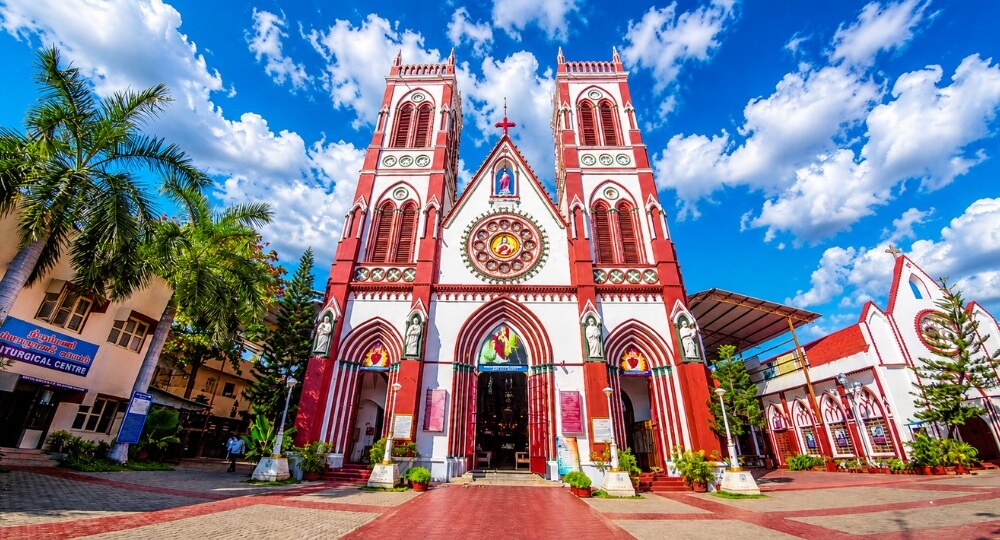
With its quaint boulevards, French patisseries, and yellow-laden walls and bright Bougainvillaea-lined homes, Pondicherry is often called the French Riviera of the East. But Pondicherry is so much more than its sophisticated French Quarter. It is home to one of the world’s most unique and long-standing social experiments in community living, Auroville. The Tamil aspect of Pondicherry is equally fascinating, with traditional Tamil-style homes in Heritage Town, temples, and bustling markets. But Pondicherry is much more than the actual Pondicherry Town. It is composed of four geographically distinct districts spanning three states: Puducherry, Karaikal (on the Coromandel Coast and bordered by Tamil Nadu), Yanam (geographically within Andhra Pradesh), and Mahe (geographically within Kerala). To learn more about this union territory and explore its districts, call us to book our Pondicherry tour packages.
Table of Content:
- About Pondicherry
- Tidbits About Pondicherry
- Things to Know Before Choosing Our Pondicherry Tour Packages
- Pondicherry At A Glance
- Top Reasons To Choose Pondicherry Tour Packages
- Best Time To Choose Pondicherry Tour Packages
- Top Tourist Attractions In Pondicherry
- Top Cities In Pondicherry
- Shopping
- Food
- Things To Remember When Visiting Pondicherry
About Pondicherry
Pondicherry or Puducherry (as it is now called) is a Union Territory comprising four districts: Pondicherry town, Yanam (within Andhra Pradesh), Mahe (within Kerala), and Karaikal (adjoining Tamil Nadu). Pondicherry town is the capital of the Territory and was once the headquarters of the French in India. It was under French rule for over 138 years, until it became a Union Territory of India in 1963. The city is often dubbed the French Riviera of the East or India’s Little France because of its impressive Gallic architecture, French Gothic-style churches, and distinct French influence, which extends even to its cuisine.
In fact, even today, you will find many Tamil residents holding French passports because of their ancestral ties to France.
French influences can be felt in other districts, such as Karaikal and Yanam, though not to the same extent as in Pondicherry. While it is logistically difficult to include Karaikal, Yanam, or Mahe in your Pondicherry tour packages, you can ask your tour manager to include these districts in other major itineraries, such as Tamil Nadu tour packages (for Karaikal) or Kerala tour packages (for Mahe).
Pondicherry is a Gallicised version of the Tamil name Puducherri, which literally means new settlement.
History
Before the French turned a fishing village into a grand port city, Puducherry had a rich maritime history that dates back to the 1st century CE, when merchants traded textiles, semi-precious stones, and pottery with the ancient Romans.
But the city’s history dates back even further, to when, according to legend, the great sage Agastya established his Ashram. According to inscriptions found in the Vedhapuriswara Temple, the place was called Agastiswaram.
The city was later ruled by different dynasties, including the Cholas, Pallavas, Pandyas, the Vijayanagara Rulers, and the Sulnates of Bijapur and Madurai, until the Portuguese settled here in the sixteenth century. Later, the French arrived here in 1670 and did not leave until 1954, when the French transferred de facto powers to India. However, it was not until 1964 that Pondicherry, along with other French provinces like Yanam, Mahe, and Karaikal, became part of the Indian Union.
Geography
Puducherry, as we know, comprises four discontinuous territories, one of which is Puducherry city, which spans 293 sq km. Pondicherry and Karaikal are bordered by the Bay of Bengal on the east and Tamil Nadu on the west, south, and north. Pondicherry has a tropical and dry climate with three distinct seasons.
Yanam is surrounded by Andhra Pradesh and is located on the banks of the Godavari River. The district has a tropical, hot climate with humid conditions, especially during summer.
Mahe is bordered by Kerala and lies on the banks of the Mahe River. The district is surrounded by Kannur on three sides and Kozhikode on the southeast. Mahe has a humid and tropical climate with heavy rainfall and high temperatures.
Similarly, Karaikal is surrounded by the Nagapattinam and Thiruvarur districts of Tamil Nadu and the Coromandel Coast to the east. It has a tropical climate with hot, humid summers and pleasant winters.
Tidbits About Pondicherry
- Except for Karaikal and Puducherry, where Tamil is predominant, Mahe and Yanam are known for their Malayalam and Telugu-speaking population and culture.
- Mahe was once a very popular surfing destination in the 70s and 80s.
Pondicherry was built on the French model of Bastide, i.e., a fortified coastal city.
- Mahe, covering around 9 km, is the smallest district in India.
- Pondicherry did not officially become part of India until 1963.
- The Dharbaranyeswarar Temple in Thirunallar (Karaikudi) is dedicated to Shani and is very famous among Navagraha Temples.
- You can drive from one end to another of Pondicherry in one day, as the entire city is less than 300 sq km.
- Arikamedu in Pondicherry is an archaeological site, and was once a famous port city with a thriving trade dating back to the 1st century CE.
- While Auroville is popularly associated with Pondicherry, a major part of the township is located in Tamil Nadu.
- Auroville has an urn which contains soil from over 124 countries deposited by over 5000 people.
Things to Know Before Choosing Our Pondicherry Tour Packages
- While Puducherry city is a popular tourist destination, we suggest you explore other regions in the Union Territory as well, including Yanam, Mahe, and Karaikal. You can club them with your Andhra Pradesh, Kerala, or Tamil Nadu tour packages, respectively.
- Carry plenty of lightweight cotton or linen clothes to keep you cool, as it can be hot during the day, even in winter.
- If you intend to meditate inside Matri Mandir, remember to book tickets at least 3-7 days in advance.
- Also, children under 10 are not allowed inside Matri Mandir.
- Check if you can include nearby attractions like Mahabalipuram and Chidambaram in your Pondicherry tour packages.
Pondicherry At A Glance
| Category |
Details |
| Capital |
Pondicherry (Officially Puducherry) |
| High Season |
October to March |
| Languages Spoken |
Tamil, English, French, Telugu, Malayalam |
| Iconic Attractions |
Sacred Heart Basilica, Manakula Vinayagar Temple, Auroville, Paradise Beach |
| State Animal |
Indian Palm Squirrel |
| State Flower |
Cannonball Flower (Nagalingam Poo in Tamil) |
| Must-Try Food |
Seafood, Pastries, Bread, French-Influenced Cuisine |
Top Reasons To Choose Pondicherry Tour Packages
Beaches
With the Bay of Bengal on its east coast, it is no surprise that Pondicherry is home to beautiful and serene beaches. Unlike Tamil Nadu, the beaches here aren’t crowded and are cleaner as a result. However, not all beaches are safe for swimming, thanks to the rocky shoreline.
The Promenade Beach, along the French Quarter, looks scenic because of the huge boulders adjacent to the French-style boulevards lined with artisanal cafes and patisseries. The beach gets its name from the 1.5 km promenade lined with benches and filled with people enjoying leisurely walks, horse rides, and even meditating. In the evening, when the area becomes a vehicle-free zone, you will find street performers, food carts, art exhibitions, and photographers.
Paradise Beach is relatively safe for swimming thanks to the shallow waters and moderate waves. But it is loved by locals for its golden-sand beaches, tranquil ambience, and scenic shoreline. The beach is popular for water sports like kayaking and banana boat rides.
Serenity Beach is a few kilometres from White Town (aka French Quarter) and, true to its name, is peaceful. In fact, the drive to the beach itself is beautiful as you drive past colourful homes and leafy streets. It is also popular among surfers and swimmers.
Eden Beach is a Blue Flag-certified beach, famous for its white, sandy shores, calm waters, and water sports. The beach has designated swimming zones equipped with clean washrooms and shower facilities.
The Auroville Beach gets its name from the nearby Auroville Township. It is famous for its calm waters, clean shores, and relaxed ambience. The calm atmosphere attracts a diverse crowd, including international tourists and Auroville residents.
Veerampattinam Beach is very close to Eden Beach and is relatively less crowded than Promenade or Paradise beaches. The beach is popular among locals who come to buy fresh fish, thanks to the ongoing fishing activities.
French Influence
Pondicherry was the capital and the headquarters of the French government in India for over 138 years. Today, what remains of the city’s colonial past are postcard-worthy avenues, colourful French villas lined with bougainvillaea trees and ornate balconies, and streets lined with artisanal cafes and bistros. Some of these historic buildings and villas on White Town (French Quarter) are now converted into boutique hotels, art galleries, and cultural centres – it’s as if stepping into a European village.
The French influence isn’t limited to the architecture. It permeates everyday life in Pondicherry through its cuisine, lifestyle, language, and even local traditions, making it one of the few reasons for travellers to fall in love with this city. Did you know that Bastille Day is still celebrated with enthusiasm in Pondicherry? When in White Town, don’t forget to sample Meen Puyabaisse, the Pondicherry version of the classic French fish soup, Bouillabaisse.
Spiritual Retreat
Besides its colonial charm, what attracts local and international tourists is the city’s spiritual escapes, such as Auroville and Aurobindo Ashram. To the uninitiated, Auroville is one of the world’s longest-standing experimental townships aimed at promoting universal harmony and sustainable living. The township now houses over 2000 people who live here, run eateries and art centres, and even manage sustainable farms.
At the heart of Auroville is Matri Mandir, a large, golden, sphere-shaped structure where you can meditate. However, you must apply for passes to visit the inner chamber of the Matri Mandir at least a week in advance.
The Aurobindo Ashram was established by Shri Aurobindo and Mirra Alfassa (aka The Mother) in 1962. The Ashram houses the Samadhis of these two founders and offers a spiritual community for seekers looking to practice higher consciousness through Sadhana, spiritual experimentation, and unselfish work. The Ashram also runs an International Centre of Education, a school focusing on integral education and progressive learning. As visitors, you can visit their meditation spaces, attend workshops on organic farming and sustainable living, read spiritual literature, and even volunteer at one of the Ashram’s cottage industries.
Temples
Despite its long-standing French influence, Pondicherry has maintained its ancient Tamil culture and traditions. This is evident in the traditional 18th-19th-century homes with Thinnais and Muttrams, and in ancient temples dedicated to Hindu gods and goddesses. The Manakula Vinayagar Temple is one of the oldest temples of Pondicherry and is dedicated to Lord Ganesha.
The Vedapureeshwarar Temple, dedicated to Lord Shiva, is at least 600 years old and one of the most popular temples in Pondicherry.
Another popular temple in Pondicherry is the Varadarajaperumal Temple dedicated to Lord Vishnu. It is believed to have been built by the Cholas during their rule of Pondicherry.
The Kannika Parameshwari Temple is one of Pondicherry’s most popular Durga temples, which is worshipped as Goddess Kamakshi.
Other popular temples in Pondicherry include the Sithanada Swamy Temple and the Thirukameswara Temple.
Food
If you’ve ever wondered what an Indianised version of French food would taste like, you must check Pondicherry’s gastronomic scene. But the best thing about this cuisine is that it’s not only Franco-Indian but also draws on its Dutch, Portuguese, and English past. You may even find Vietnamese and Bengali influences. And if you are lucky, you may even sample some of Pondicherry’s unique Creole-inspired dishes, some of which were rediscovered from old recipe books written by the Franco-Pondicherrians or Bas Creoles, as they are called.
It is only in Pondicherry that you can begin your day with a croissant while sipping on a cappuccino or enjoy a savoury galette. Don’t miss sampling some of the best hot baguettes, sumptuous eclairs, macarons, and artisanal pastries at Baker Street. French crepes are equally popular, along with Chaiyos, a Vietnamese-influenced spring roll.
And if you are craving South Indian food, there are plenty of restaurants offering staples like Idli, Dosa, Vada, and Pongal.
Try the Indianised version of French classics like Bouillabaisse (Meen Puyabaisse) and Coq Au Vin.
Unique Shopping
Pondicherry is known for offering a unique shopping experience. You can buy artisanal products like handmade or hand-embroidered clothes, natural beauty products, artisanal cheese, organic incense sticks, papercrafts, leather goods, curated pottery, and even organic skincare products.
Some of Auroville’s workshops sell unique souvenirs like handmade books and lampshades, wrapping paper, and even greeting cards, all made from recycled paper. Homemade jams, tarts, soaps, and cheeses are also popular here.
The best thing about shopping in Pondicherry is that many of the products you find here are sustainable and handmade, making them one-of-a-kind. If you’d like to decorate your home with curated knick-knacks, Pondicherry is the place to be.
Unique Experiences
If you’re tired of the many run-of-the-mill tour packages, Pondicherry is right for you. Here, you can enjoy unique experiences such as art and pottery workshops, music workshops, yoga and meditation retreats, and cultural events like the Bastille Day Parade and street art festivals.
If you enjoy water sports, sign up for activities like kayaking, scuba diving, surfing, and jet skiing.
Exploring the experimental township of Auroville is a unique experience in itself. Sign up for a heritage tour of White Town and Ville Noire, or go café hopping on Baker Street.
If you love toys, visit the Jawahar Toy Museum to check its collection of dolls from across India. If you love birds, check the Ousteri Lake.
You can sign up for stargazing and astronomy events held regularly across Pondicherry.
Best Time To Choose Pondicherry Tour Packages
Pondicherry has a tropical savannah climate with the weather ranging from hot to the hottest. It is sometimes dry and windy during winter and almost always overcast during the monsoon. Summers are hot and humid, while winters are mild. The city also experiences moderate to heavy rainfall from northeast clouds between October and December. Read on to learn more about the city’s climate and the best time to choose Pondicherry tour packages.
Summer (March to June)
Pondicherry experiences a tropical, hot, and humid climate, with temperatures ranging from 22°C to 36°C, and occasionally reaching 40°C. Humidity can reach 93% during these months. But Pondicherry, being a coastal city, has temperatures that come down in the evening, making your stay pleasant. We suggest avoiding heading out in the summer months. In fact, the town moves at a surprisingly slow pace in summer from 9 am to 4 pm, but becomes busy in the evening. And if you do head out, carry an umbrella or a hat.
This is the low season, but the best time to choose Pondicherry tour packages if you are on a budget and looking to avoid tourist rush.
Monsoon (October to December)
Pondicherry receives the Northeast monsoon, characterised by moderate to heavy rainfall and occasional cyclones. October to November is when it rains the most, contributing to over 70% of the state’s water resources. It receives very little southwest monsoon rains that roll over the rest of the country from July to September, as the region lies in the shadow of the Western Ghats.
This is typically off-season in Pondicherry, but the perfect time for budget Pondicherry tour packages.
Winter (January to February)
This is the best time to book Pondicherry tour packages, thanks to the pleasant climate, which ranges from 27°C to 32°C, but rarely falls below 23°C. January is the coldest month of the year, with the average temperature at 28°C.
Top Tourist Attractions In Pondicherry
French Quarter
This is the highlight of every Pondicherry tour package and hands down the city’s most popular attraction. Also called White Town, this 17th-century seaside district comprises beautiful colonial buildings with arched windows and doors, ornate balconies and colourful bougainvillaea draping pastel coloured walls. The streets are immaculately clean, quiet, and lined with trees. Some of the villas are now converted into heritage guesthouses or Airbnb homes. To give tourists the complete French colonial experience, some of these places serve authentic Franco-Tamil and Creole dishes.
The best way to experience the French Quarter is to take a cycle rickshaw or drive a scooter. Don’t miss some of the famous bakeries and bistros on Baker Street. La Maison Rose is another iconic restaurant on Rue Romain Rolland, the heart of White Town.
Some of White Town’s other legendary buildings include Raj Nivas, the Église Notre-Dame-des-Anges, the French War Memorial, the Cluny Embroidery Centre, the Alliance Française, the French Consulate, Rue Dumas, and Rue Suffren.
Tamil Quarter
There are two Pondicherrys, and they are separated by a canal. While one is famous for its French colonial heritage, the other is distinctly Tamil. It was once called Ville Noire or Black Town, but thankfully, it is now popularly referred to as Tamil Quarter or Heritage Town. Unlike Ville Blanche (or White Town), the streets here are lined with Tamil homes complete with a Thinnai and Muttram, although you will find some French-influenced architecture here and there. Also, unlike the pastel-coloured homes in the French Quarter, the homes here are colourful, lively, and intimate.
Within the Tamil Quarter, you will find the town further segregated into Hindu, Christian, and Muslim Quarters, with names like Perumal Street, Mullah Street and Cathedral Street, respectively.
Some of these houses are now converted into guest houses or heritage hotels, allowing guests to explore Pondicherry’s unique Dravidian heritage. Besides the centuries-old temples, you must check the Grand Bazaar and beautiful Tamil-style homes like Maison Perumal.
Auroville
Auroville is an experimental township established in 1968 by Mirra Alfassa, also called The Mother. It is about 11 km from Pondicherry town, but can be reached by bus, auto, or taxi. Interestingly, most of this township lies within the Viluppuram District of Tamil Nadu, with only a few kilometres stretching into Pondicherry. The township is endorsed and supported by UNESCO for its efforts to promote human unity and sustainable living.
The highlight of the township is Matrimandir, a huge golden sphere-shaped dome where visitors can meditate and seek inner solitude. Auroville is divided into different zones, namely residential, research centres, and green spaces.
The homes and buildings here practice eco-friendly practices such as organic farming, renewable energy, sustainable architecture, and water conservation.
Besides Matrimandir, other attractions within Auroville include the Botanical Garden, Auro Beach, and the Visitors Centre. You can also stay within Auroville or volunteer for some of their short or long-term community projects.
Besides the many French bakeries that serve artisanal breads and cheeses, you can buy handmade paper and handmade diaries and notebooks, organic incense sticks, handmade soaps and skincare products, and even home décor. Handmade musical instruments, unique tableware, home décor, fresh organic honey, and homemade jams are some of the unique souvenirs you can buy for friends and family at Auroville.
Aurobindo Ashram
Aurobindo Ashram is a popular attraction in the French Quarter. The Ashram was founded by Shri Aurobindo in 1910 and later managed by Mirra Alfassa, also called The Mother. It houses the Samadhis of Shri Aurobindo and Mother, and is a place of inner learning for spiritual seekers. Visitors must leave their footwear and bags outside before entering the Ashram. Your tour of the Ashram begins with a visit to the tombs of the founders and includes meditation spaces, libraries, educational centres, community clinics, and cultural halls.
You can join the collective meditation session or volunteer for opportunities like library assistance and organic farming.
The Aurobindo Ashram also houses the International Centre of Education, an experimental school that teaches children human unity and divine consciousness.
Manakula Vinayagar Temple
The Manakula Vinayagar Temple is dedicated to Lord Ganesha. The temple’s unique name comes from the sandy natural pond where the temple was originally located, i.e., Manal (sand) Kulam (pond). It was earlier called Manal Kulathu Vinayagar, which was later shortened to its present name.
Some believe that the French tried to dispose of the idol, which was self-manifested (Svayambhu), by throwing it into the sea. But every time they did so, the idol reappeared. They finally gave up and installed the deity in the French Quarter. While someone did try to destroy the temple, they had to give up due to strong protests by the local community and the threat of Maratha invasion.
This east-facing temple’s highlight is the gold Kodi Maram or pillar, which greets devotees. The temple’s interiors are adorned with various sculptures and paintings of Lord Ganesha, along with engravings of Ashta Lakshmi, Lord Murugan, and Ganesha.
Promenade Beach
The Promenade Beach gets its name from the 1.5 km seafront boulevard on the edge of the French Quarter, serving as its boundary. During the French rule, it served as a military asset, but later underwent extensive beautification. Today, it is one of the highlights of the French Quarter experience, lined with benches where tourists can enjoy views of the Bay of Bengal.
It is also called Rock Beach because of the large boulders along the shore, installed by the Puducherry government to prevent sea erosion.
The Beach is also home to several landmarks, including the Mahatma Gandhi Statue, the Dupleix Statue, the War Memorial, and the Heritage Town Hall.
Another popular activity along the beach is visiting the cafes and bakeries lined along the shore. In the evening, the promenade is a vehicle-free zone, making it a popular place for locals to jog, practice yoga, and enjoy other activities. Occasionally, you will also find street performances and art exhibitions along the promenade.
Arikamedu
Arikamedu is a significant archaeological site and a once-bustling port where traders exchanged goods and cultural influences with the Romans during the 1st century CE. It is believed that Romans would arrive here to buy semi-precious stones, pottery, and high-quality textiles. Archaeologists have uncovered important artefacts like Roman coins, pottery, and amphorae. The site, along with a nearby ancient port, Virampattinam, is mentioned in Ptolemy’s Geographia as Podoke, a corruption of the Tamil word Potikai.
Arikamedu isn’t marketed as a tourist site and is hardly mentioned in many Pondicherry tour packages. But if you are interested in ancient history and would love to explore this place, we can certainly include it in your itinerary.
Paradise Beach
This is one of Pondicherry’s most iconic beaches, accessible by boat through the Chunnambar Boat House. This secluded beach is less crowded but looks beautiful thanks to its pristine, palm-tree-lined shores and calm waves. The beach is popular among locals for surfing and swimming. It was especially popular among the hippie crowd of the 70s and 80s, often frequented by tourists visiting the Aurobindo Ashram.
Today, you can enjoy scenic views of the Bay of Bengal while lying on small shacks and benches, relishing street food like fried fish and other local delights.
Mahabalipuram
Mahabalipuram is technically part of Pondicherry, but is often clubbed with Pondicherry tour packages due to its proximity to the city. The UNESCO World Heritage Site is hardly a two-hour drive from Pondicherry. Mahabalipuram is famous for its 3rd-8th-century rock-cut monuments of the Pallava Dynasty. It features shore temples, monolith sculptures, and cave temples.
Mahabalipuram was once a busy port where trade with the Romans was conducted. Archaeologists have uncovered Roman coins and other artefacts to support this discovery.
Some of Mahabalipuram’s iconic architectural masterpieces include the Adi Varaha Cave Temple, the Trimurti Cave, the Mahishasuramardhini Caves, and open-air bas-reliefs such as the Descent of the Ganges. Locals believe that the iconic Shore Temple is the only surviving structure of the Seven Pagodas, which are believed to have drowned during a great flood that occurred between 10,000 and 13,000 BCE. In fact, Mahabalipuram was once referred to as the Land of the Seven Pagodas by ancient mariners. This local folklore is also supported by scientists who have conducted underwater exploration.
Other interesting artefacts in Mahabalipuram include the Olakkanatha Temple and Sri Krishna’s Butterball.
Serenity Beach
The Serenity Beach isn’t as popular as other beaches, but it is loved for its serene atmosphere and beautiful sunrises/sunsets. It is also an active fishing place where you will find locals arriving throughout the day.
There’s also a surf school catering to tourists and locals looking to learn surfing.
Sacred Heart Basilica
Located close to the French Quarter, the Basilica of the Sacred Heart of Jesus was constructed in 1902 and is famous for its beautiful Indo-French architecture. The church is home to rare stained-glass panels depicting the life of Jesus and Catholic saints. The church was consecrated as a basilica in 2011.
Chunnambar Boat House
The Chunnambar Boat House is most visited by tourists looking to explore Paradise Beach. Located on the backwaters, Chunnambar is known for its lush green meadows and pristine sands.
You could either book a treehouse at Chunnambar for the night or sign up for a houseboat cruise, sailing past paddy fields and villages and offering breathtaking views of the dense coconut groves.
Eden Beach
Eden Beach is a Blue Flag beach known for its clean shores and eco-friendly practices. The beach looks idyllic, with coconut plantations and the Chunnambar backwaters in the background.
Eden Beach also has a designated swimming zone complete with washrooms, sit-outs, umbrella huts and lifeguards. Children can enjoy at the play area while adults can sample some of Pondicherry’s delicious street food.
In winter, the beach becomes a bird-watching hotspot thanks to the rare migratory birds like golden plovers, oystercatchers, herons, and egrets that visit the place.
Top Cities In Pondicherry
Yanam
Yanam is a district located within the East Godavari district in Andhra Pradesh, but technically part of the Union Territory of Puducherry. It is famous for its colonial architecture, scenic riverside views, temples, and its unique cultural blend of French and Telugu traditions. Yanam is also famous for its mangroves, viz., the Coringa Wildlife Sanctuary, which is one of the largest mangrove forests of South India.
Mahe
Mahe is surrounded by Kannur and Kozhikode districts on one side and the Mahe River on the other. It is also the smallest district in India by land size. Today, the place is known for its French colonial architecture and picturesque views of the Mahe River. Some of Mahe’s well-known tourist attractions include the Statue of Marianne, the Miracle Church of St Theresa of Avila, and the Mahe Lighthouse. You can include a visit to Mahe in your itinerary when choosing Kerala tour packages.
Karaikal
Karaikal is a port city on the border of Tamil Nadu and the Bay of Bengal. While the town has several neo-Gothic, French-inspired buildings, like Our Lady of Angels Church, people often visit Karaikal as part of their Navagraha tour, thanks to the Thirunallar Darbaranyeswarar temple dedicated to the planet Saturn, or Lord Shani. People also visit the 7th-century temple of Karaikal Ammaiyar, considered one of the 23 Nayannmars of the Shaivite tradition.
Tourists visiting Velankanni and Nagore also visit Karaikal as part of their tour.
Shopping
Pondicherry is a great place if you love eclectic things and appreciate handmade souvenirs. From handmade notebooks and diaries to homemade jams, tarts, and juices in Auroville to stores selling handmade brass lamps and figurines in Vysial Street, there’s so much to appreciate.
If you visit Auroville, don’t forget to shop for artisanal cheese and breads along with handmade products like soaps, incense sticks, aromatherapy candles, skincare products, and even organic honey. Handwoven baskets, terracotta artefacts, paintings, and wooden figurines are also popular souvenirs.
Pondicherry is the headquarters of India’s largest leather brand, HiDesign. You will find genuine leather goods like belts, purses, and bags for cheap. In fact, HiDesign products are cheaper in Pondy than anywhere else in India.
If you love boho-chic, head to Serenity Bazaar for boho-chic clothes, hand-painted ceramic items, and unique bags and shoes.
The Goubert Market in the French Quarter is famous for its organic and fresh produce, while Nehru Market is a great place for bargain hunters looking for home décor, electronics, and quirky souvenirs.
Head to Vysial Street for brass lamps, sculptures, and other antique items. Head to Mission Street to buy Kalamkari kurtas and sarees.
Food
Traditional Pondicherry cuisine is a blend of Tamil and French influences, in the sense that the locals borrowed French cooking techniques and adapted them to their tastes with spices and local ingredients. For instance, the French classic fish Bouillabaisse is adapted as Meen Puyabaise, a curry relished with rice. But what makes it even more interesting is that Pondicherry cuisine also draws influences from Dutch, Portuguese, English, and Vietnamese cuisine.
Of course, you can still find the typical Tamil cuisine like Meen Curry, Idli and Vada Curry, or Dosa, Sambar, and Wada. But if you are craving something unique, head to Chez Pushpa to sample meals that include mutton sambar, pork vindaloo, duck Vadavoum, and the Vietnamese Cha Gio. This is the best place to sample Pondicherry’s Creole food.
You cannot visit Pondicherry and not sample some of the hot breads and pastries along Bussy Street and Goubert Avenue. Baker Street in White Town is iconic and famous for its croissants, macaroons, eclairs, and French sandwiches.
And if you love street food, sample some of its popular snacks like chicken bonda and prawn bhaji. For seafood lovers, there’s also a soft-shell crab version of this bhajji. The Pondi Patti Bhajji shop is very famous for these fried seafood snacks.
To sample Burmese food, head to Burma King to sample Atho, Khao Suey, and Mutta Bhejo, served with plantain soup.
And if you are looking for some mutton dishes, head to Nizam Soup Stall for mutton samosa and paya soup.
Given its seafood culture, you must not miss Pondicherry’s Fish 65 or Naethilli Fry.
And to end your street food tour, you must finish with milk sherbet flavoured with sabja seeds and nannari.
Things To Remember When Visiting Pondicherry
- Most of Pondicherry goes quiet after 10 pm. We suggest avoiding late-night strolling unless you are in a group.
- Make the most of your time in Pondicherry by signing up for niche workshops like pottery, clay moulding, baking, cheese tasting, and even sound therapy (in Auroville).
- Dress modestly when visiting temples and spiritual communities like Aurobindo Ashram.
- Book your passes 3- 7 days in advance if you’d like to include a visit to Matrimandir. Also, Matrimandir is closed on Sundays and Tuesdays.
- Remember, Matrimandir isn’t for everyone. You must maintain strict silence and avoid religious rituals. Also, children are not allowed within Matrimandir.
- While New Year’s Eve is a popularly touted event in Pondicherry, we suggest avoiding the place, especially the beaches, if you hate unruly scenes of people driving like crazy or honking incessantly. There are a few places where you can enjoy a good drink and fine company – but they’re usually booked in advance.